
When we lift sagging breasts, what are we actually moving?
A Short J-Incision Breast Lift Case
Hello, I’m Dr. Jinhye Bae, a breast surgeon at MAMMS Clinic Plastic Surgery.
Today I’m starting a new series in which we look closely at real breast surgery cases and learn how to read breast shape together. Simply saying a breast looks “higher” or “prettier” in the after photo misses most of the story. Every patient has a different frame, breast shape, skin elasticity, tissue density, and direction of sagging. Once we ask why a breast looked heavy and what needed to change surgically, breast lifts and breast reductions become much easier to understand in three dimensions. This series is not just about comparing before-and-after photos—it is about developing a more informed eye for breast shape.
Think of me as your guide through the gallery. Let’s begin.
Today’s question is: “How does a sagging breast actually move upward?”
What mattered most to the patient was correcting the sagging.
“My breasts look wide and seem to hang downward, so even in clothes, the shape doesn’t look flattering.”
But when I examined her anatomy more closely, sagging was not the only issue.
There were slight differences in size and degree of ptosis between the two sides, and much of the breast volume was concentrated in the lower pole, while the upper pole looked relatively hollow.
So I needed to address three things at the same time:
lift the sagging tissue, improve the asymmetry, and redistribute the breast volume so the upper pole would not look even more depleted.
1. What does it really mean to “lift” a sagging breast?
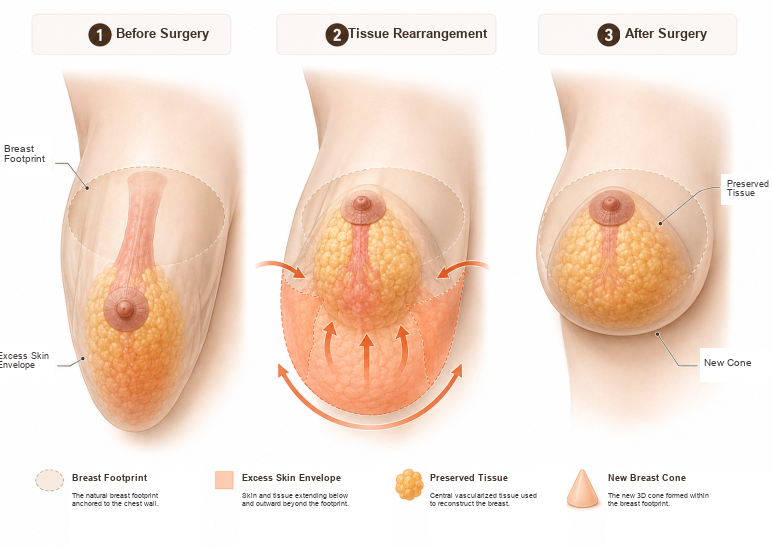
How Breast Tissue Rearrangement Works (Courtesy of MAMMS Clinic Plastic Surgery)
We do not simply pick up the entire breast and move it upward as one piece.
The structures that move the most are the nipple–areola complex and the surrounding breast tissue.
The nipple is not detached and reattached. Instead, it remains connected to its blood vessels, nerves, and breast tissue on a pedicle, and this unit is moved upward.
The distance varies from patient to patient. The more severe the ptosis, the farther the nipple needs to travel. That is why the pedicle must be designed with enough length and mobility to reach the new position while still maintaining reliable blood supply to the nipple.
In this case, I moved the nipple–areola complex and surrounding tissue upward while preserving the tissue needed to maintain blood flow and sensation.
As the most projecting central portion of the breast moves upward, the breast’s overall center of gravity rises with it.
2. Define the breast footprint and remove the excess that hangs below it
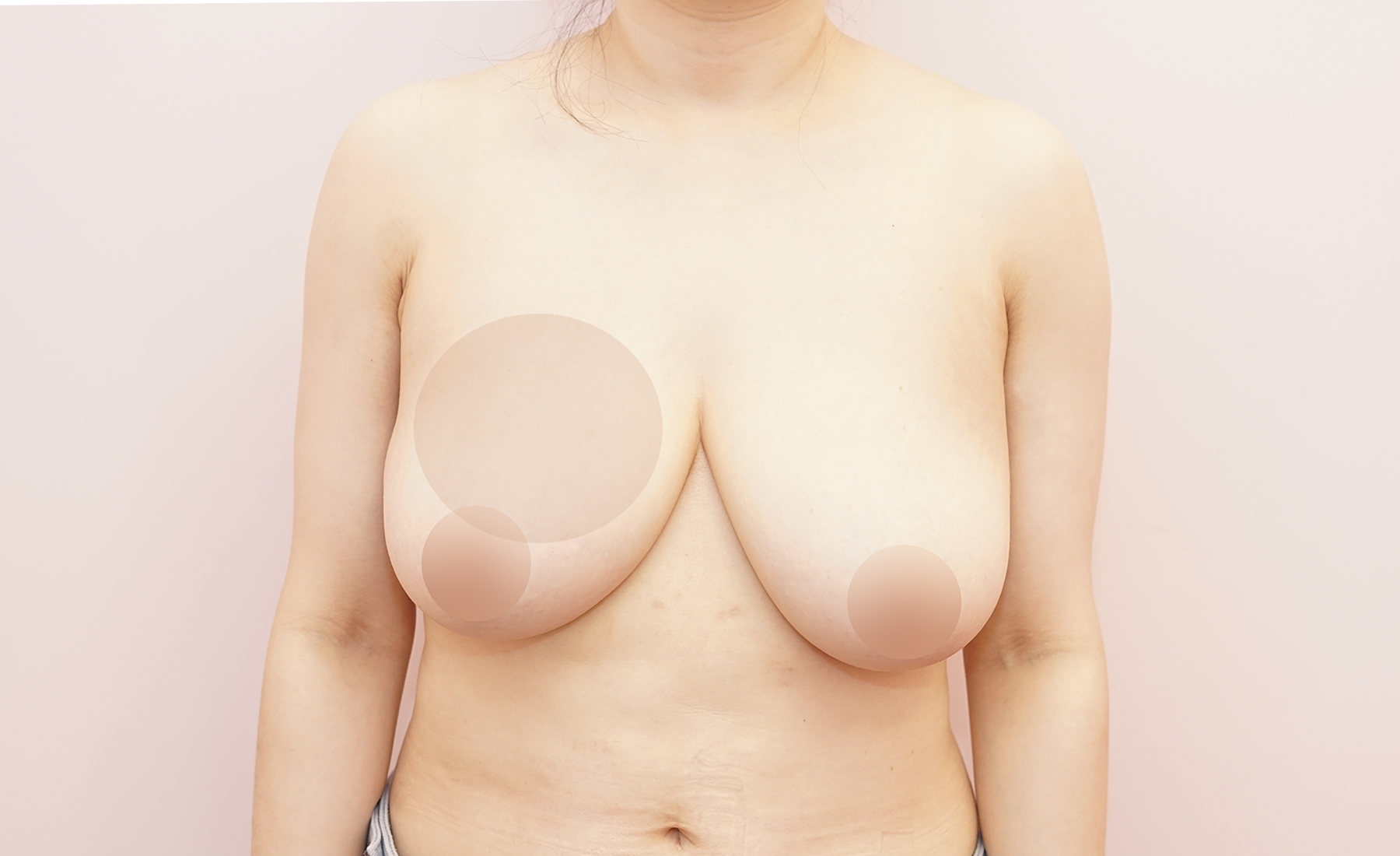
The breast is reshaped according to its breast footprint. (Preoperative photo, January 2026)
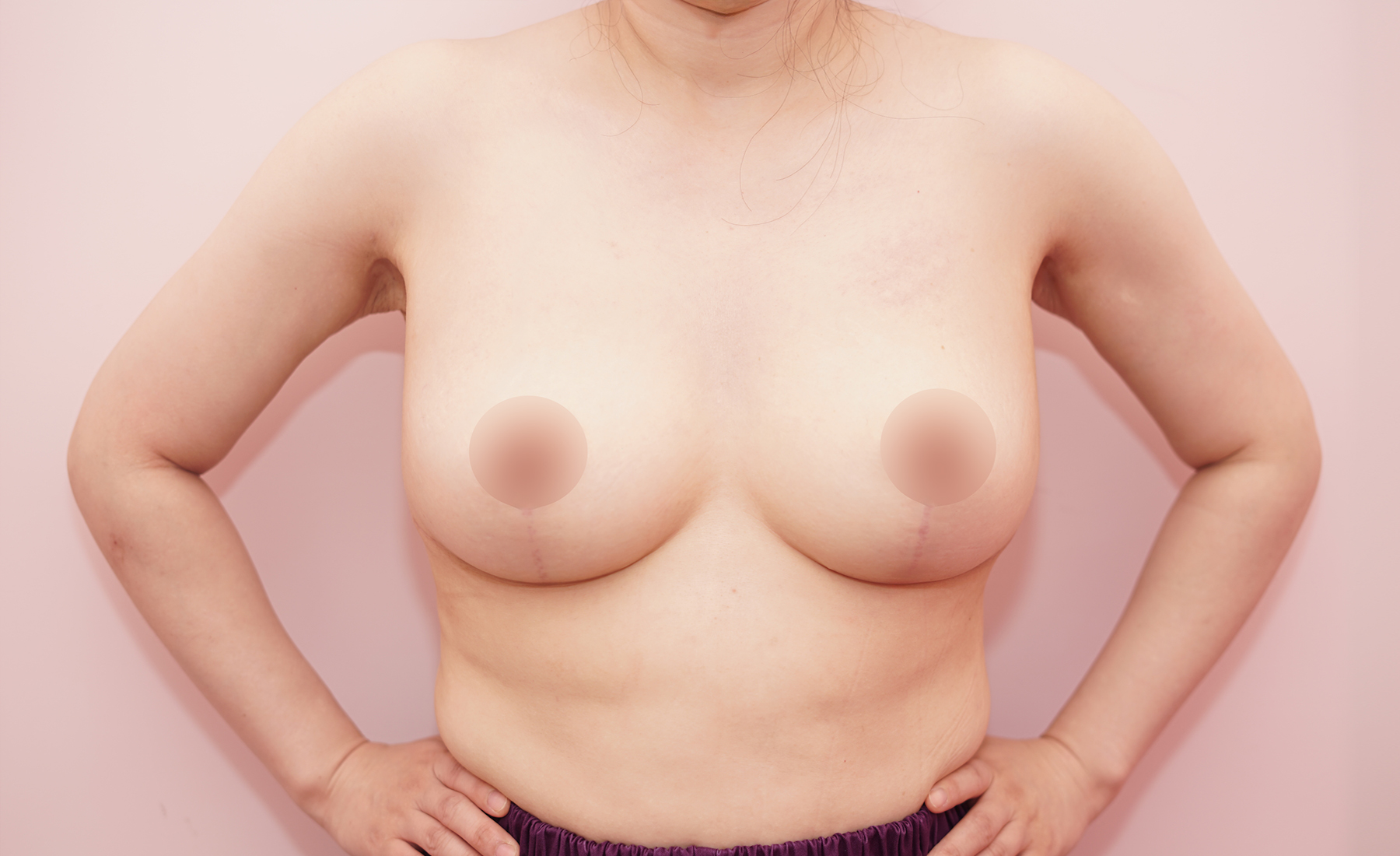
(Postoperative photo, August 2026)
So where does the tissue that hangs downward actually go? This is one of the key principles of a breast lift.
In the preoperative photos, the skin and tissue extend well below the area where the breast should naturally sit.
I begin by defining the breast footprint—the natural base area the breast should occupy on that patient’s chest.
The breast footprint is the rounded area defined by the upper and lower boundaries and the medial and lateral boundaries of the breast. It is the natural territory the breast occupies on the chest wall.
You can think of it as the breast’s foundation, outlined by its upper, lower, inner, and outer borders.
This footprint is largely determined by the patient’s rib cage, inframammary fold, skin, and tissue quality. A breast reduction is therefore not simply about making the breast as small as possible while ignoring those boundaries.
Skin and tissue hanging below that footprint are removed when they are not needed to create a well-shaped breast.
The remaining breast tissue is then brought together and shaped into a three-dimensional breast form.
Put simply,
we do not push the entire sagging breast straight upward.
We remove the stretched, unnecessary portions and rebuild the breast with the tissue that remains.
3. Because the upper pole was hollow, deciding which tissue to preserve mattered
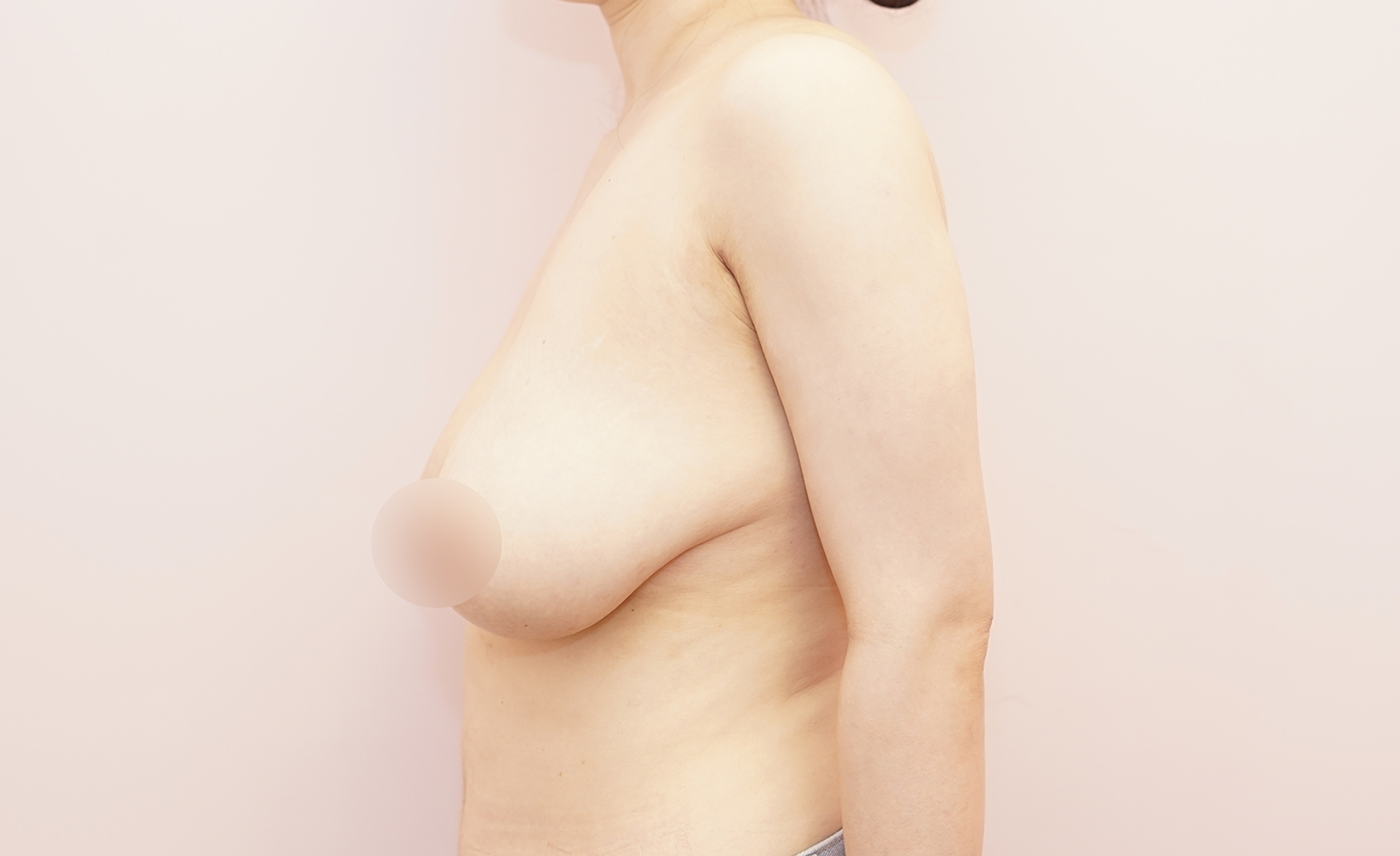
(Preoperative photo, January 2026)
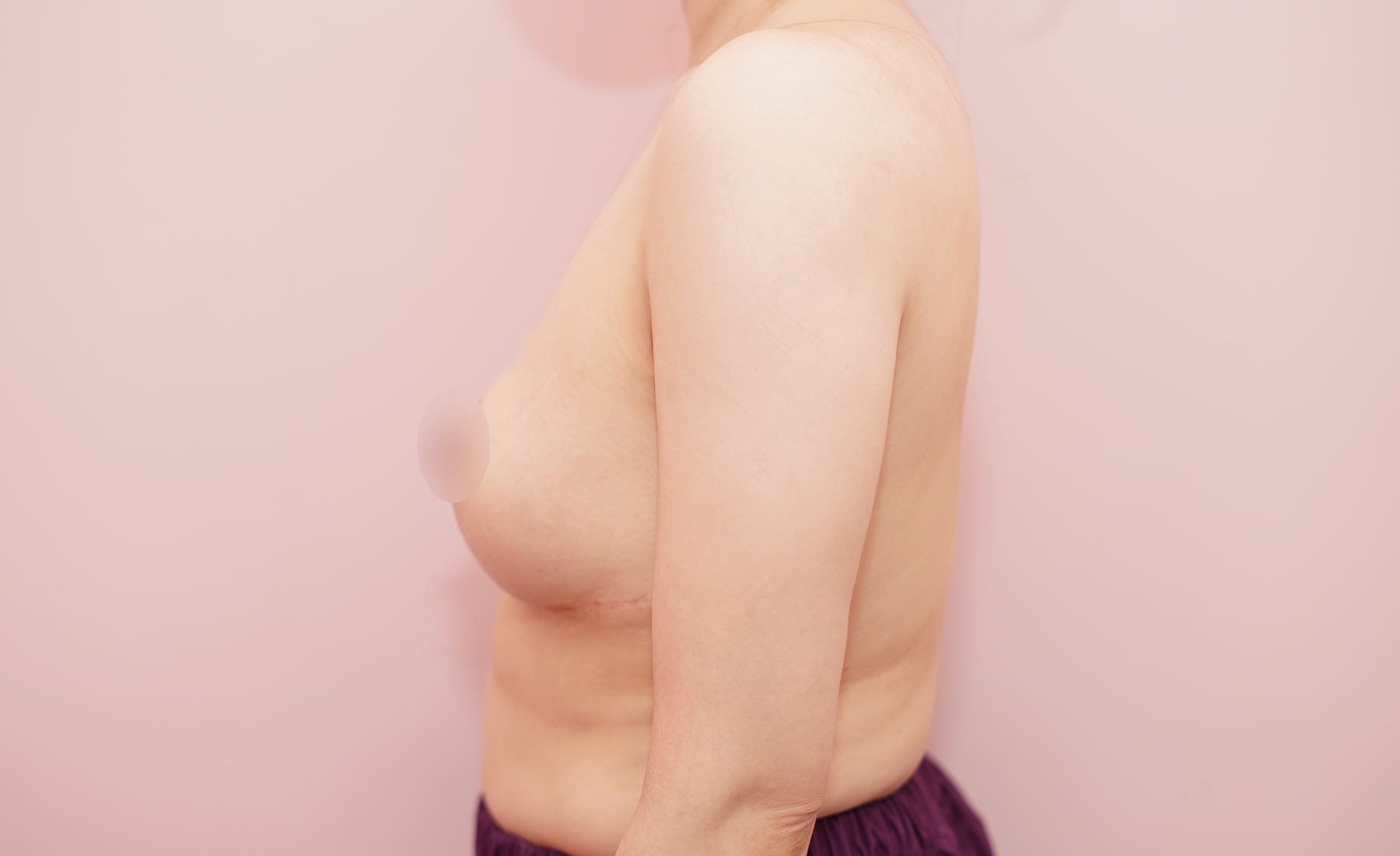
(Postoperative photo, August 2026)

(Preoperative photo, January 2026)
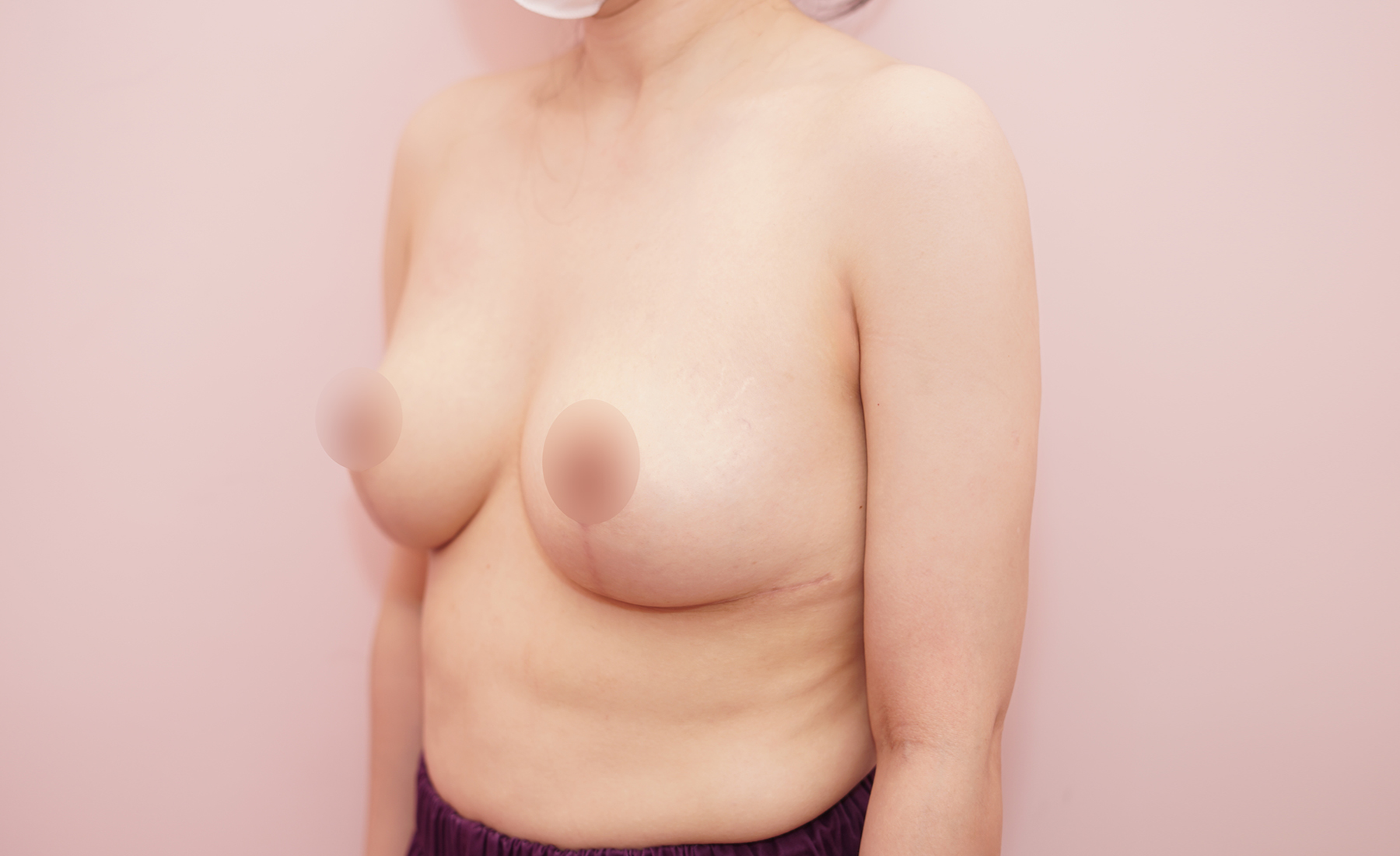
(Postoperative photo, August 2026)
Even before surgery, this patient had relatively limited upper-pole volume.
If too much tissue is simply removed from the lower breast in a case like this, the breast may become smaller and less saggy, but the upper pole can look even more hollow.
So I do not focus only on how much tissue to remove.
I also decide which tissue to preserve and where to position it.
This is called breast tissue rearrangement.
By rearranging the remaining breast tissue, I shifted the center of the breast upward, narrowed the broad appearance from the front, and created natural projection from the side.
4. The nipple position is not chosen by marking a single point at the outset
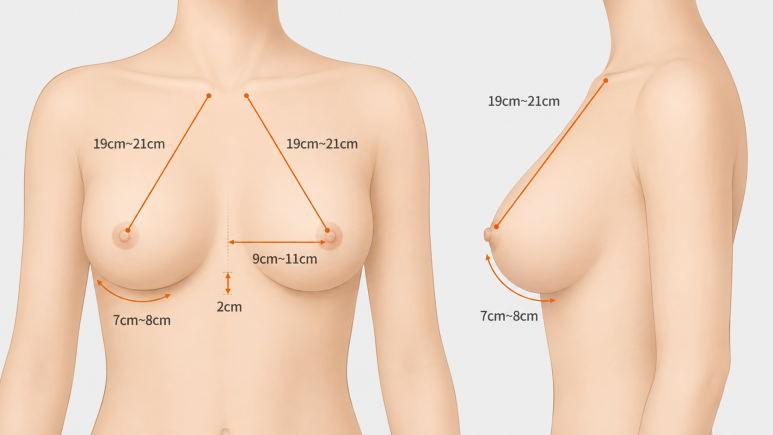
Basic Aesthetic Landmarks (Breast Aesthetic Proportion Diagram, Courtesy of MAMMS Clinic Plastic Surgery)
One of the most visible parts of a breast lift is repositioning the nipple,
but placing the nipple as high as possible does not automatically create an attractive breast.
Breast surgery uses several basic aesthetic landmarks, often summarized in a breast aesthetic proportion diagram. One commonly referenced measurement is the distance from the suprasternal notch—the hollow at the base of the neck—to the nipple.
The important point is that these numbers are not absolute rules.
They vary with height, chest width, underbust circumference, breast footprint, skin elasticity, and degree of ptosis.
For a breast lift, I interpret those measurements this way:
the goal is not to place every nipple at 19–21 cm.
The operation must be designed around the patient’s own rib cage and breast footprint,
so the nipple position, lower-pole length, inframammary fold, and breast axis all come into natural alignment.
I consider the breast shape that will be created when the remaining tissue is brought together,
as well as how that tissue will settle over time under the influence of gravity.
Within that newly shaped breast, I place the nipple at the point of the most natural forward projection, the point of maximal projection.
Rather than deciding how many centimeters to raise the nipple based only on its preoperative position,
I first ask where the nipple should sit within the final breast shape.
5. Why did I use a short J-incision instead of a vertical incision?
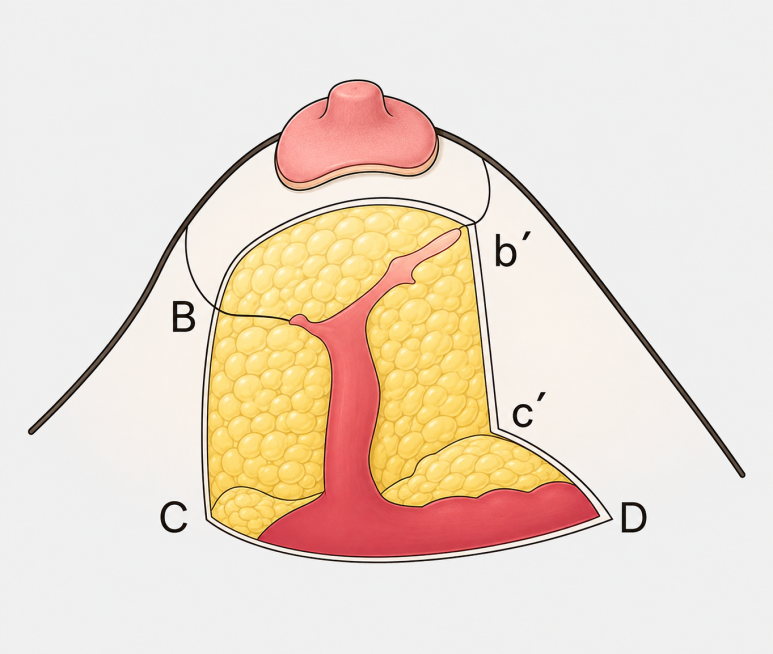
In breast lift surgery, incision length is not the technique itself—it is the result of removing the stretched skin that needs to be addressed. (Courtesy of MAMMS Clinic Plastic Surgery)
During breast lift consultations, many patients ask for a vertical-only incision because they want the shortest possible scar.
However, when the lower breast skin is significantly stretched, as it was in this case, forcing all of the excess skin into a vertical incision can create puckering and excessive tension.
If skin elasticity is poor, the incision may look short at first, but as the skin stretches again, it can lead to recurrent lower-pole sagging or scar extension.
For that reason, I remove as much stretched skin as necessary when it extends beyond the natural breast footprint.
If stretched skin below the natural breast footprint is left in place, the lower pole may remain too long and continue to look saggy even after the breast tissue has been gathered upward. My priority is therefore not simply to make the scar as short as possible, but to remove enough excess skin for the newly shaped breast to remain stable in its proper position.
In this patient, there was not enough excess skin to require a long inverted-T incision along the inframammary fold.
Because most of the excess skin was on the outer side,
I completed the lift with a J-incision that extended only a short distance laterally along the inframammary fold.
In other words,
I did not choose a J-incision simply to make the scar shorter.
The short J was the result of the amount and location of skin that actually needed to be removed.
Breast lifts and breast reductions share the same basic principles
To lift a sagging breast properly, stretched skin and some tissue need to be removed.
That is why breast lifts and breast reductions are based on many of the same surgical principles.
The key difference is that a breast reduction also involves removing more internal breast volume.
A lift focuses on reshaping the breast while preserving as much volume as possible,
whereas a reduction removes additional internal breast tissue as needed during the reshaping process.
Today’s question was: “How does a sagging breast actually move upward?”
A sagging breast is not lifted simply by pulling the skin upward.
It rises when the stretched lower skin is removed, the remaining breast tissue is reshaped, and the center of gravity is moved upward.
The nipple must then be positioned at the most natural point of projection on the newly shaped breast
for the result to look balanced and natural.
Ultimately, a breast lift is not simply an operation that pulls the breast upward.
It is an operation that analyzes the structures that have descended and rebuilds the breast around a new center.
This has been Dr. Jinhye Bae of MAMMS Clinic Plastic Surgery.